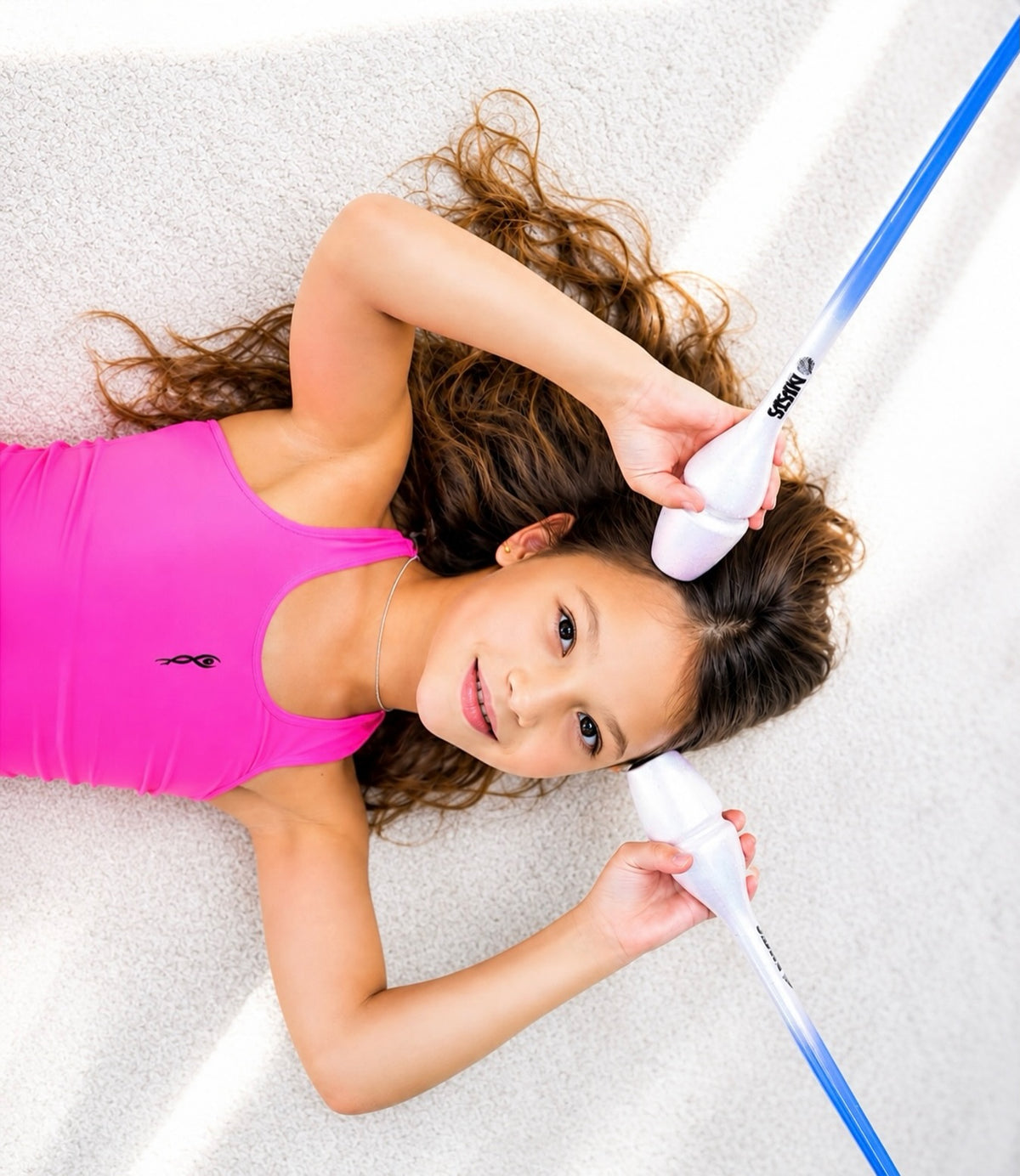
Gymnastics Ribbons - How to Choose the Right One?
A complete guide to ribbon lengths, materials, colours and sticks for training and competition
The ribbon is one of the most spectacular pieces of apparatus in rhythmic gymnastics — and one of the trickiest to master. Too short, and the shapes look small. Too long, and a young gymnast will struggle to control it. The wrong material tangles. The wrong stick length throws the whole thing off balance.
This guide explains how to choose the right ribbon length for your gymnast's age and level, what to look for in materials and construction, how to pair a ribbon with the right stick, and how to look after both.
How long is a rhythmic gymnastics ribbon?
Rhythmic gymnastics ribbons come in three standard lengths: 4 metres, 5 metres and 6 metres. The correct length depends on the gymnast's age and competition level.
4-metre ribbons
Four-metre ribbons are designed for the youngest gymnasts — usually those aged 10 and under, or those who train recreationally. The shorter length is easier to control, making it ideal for learning basic ribbon skills such as spirals, snakes, circles and throws. Most 4 m ribbons are not FIG-approved, as they are intended for training and early development rather than formal competition.
5-metre ribbons
Five-metre ribbons are the standard for junior gymnasts competing under national or regional federation rules. They are generally used by gymnasts aged roughly 11 to 14, although exact age limits vary by federation and competition level. Pastorelli 5 m ribbons (listed as 5.2 m to allow for re-stitching at the attachment point) are FIG-approved for junior individual and group competition.
6-metre ribbons
Six-metre ribbons are the senior competition standard. All gymnasts aged 14 and over — and anyone taking part in FIG-level events, including national championships, the European Championships and the World Championships — must use a 6-metre ribbon. Pastorelli 6 m ribbons (listed as 6.2 m, with extra length for re-stitching) weigh just 37 grams, only 2 grams above the FIG minimum. Chacott's 6 m Infinity ribbon is another popular FIG-approved option.
Quick length guide
| Age / Level | Ribbon length | Typical use |
|---|---|---|
| 10 and under / recreational | 4 m | Training, beginner classes, early development |
| 11-14 / junior competition | 5 m | National junior events, regional competitions |
| 14 and over / senior competition | 6 m | All FIG-level competitions, national and international |
Important: These are general guidelines. Age rules can vary between federations and competition levels. Always check with your coach or club before buying a competition ribbon to confirm the length required.
What makes a good rhythmic gymnastics ribbon?
Not all ribbons are equal. At competition level, even small differences in weight, weave and stiffness change the way a ribbon moves through the air. Here is what to look for.
Weight
Lighter ribbons produce bigger, more fluid shapes — exactly what judges want to see. The FIG minimum weight for a senior ribbon is 35 grams. The best competition ribbons sit just above that minimum. Pastorelli ribbons, for example, weigh 37 grams at 6 m. Heavier ribbons feel sluggish and produce smaller patterns, so for competition, lighter is better.
Material and weave
Competition ribbons are made from a woven, satin-like fabric — not the thick, stiff material sometimes seen on cheap recreational ribbons. The weave needs to be fine enough to keep the weight down, yet strong enough to withstand the force of throws, catches and rapid changes of direction.
Pastorelli ribbons are woven using a traditional craft technique that prioritises lightness without sacrificing strength. Chacott ribbons are made with anti-static thread, which reduces the static cling that can make a ribbon stick to itself or to the gymnast during a routine — a useful advantage in dry indoor venues.
Colour and pattern
Ribbon colour is about more than looks. In competition, judges need to see the ribbon clearly throughout the routine, so bright, saturated colours work better than pale or muted tones. Most brands offer ribbons in three styles:
- Single colour — One solid colour. Clean and classic. Available in a huge range of shades.
- Multicolour / gradient — Two or more colours blending along the length of the ribbon. Striking under competition lighting and popular for creating a coordinated look with leotards.
- Metallic or holographic accents — Some ribbons feature metallic thread or a subtle shimmer. These catch the light beautifully, but check the FIG regulations, as some finishes may not be approved for every competition.
Many gymnasts choose ribbon colours that complement their leotard and music for a cohesive overall presentation.
Ribbon brands compared
Pastorelli
The most widely used ribbon brand in competitive rhythmic gymnastics worldwide. Pastorelli ribbons are known for their exceptional lightness (37g at 6m), vibrant colours and reliable performance. Available in single colour and multicolour, in all three lengths. FIG-approved at 5m and 6m. The preferred choice of most competitive gymnasts.
Chacott
Japanese brand Chacott makes the Infinity ribbon range — a premium option with anti-static thread and beautiful colour gradient effects. Available in 5m and 6m, FIG-approved. Chacott ribbons feel slightly different from Pastorelli — some gymnasts prefer the way they move through the air. It is worth trying both to see which suits your gymnast's style.
Sasaki
Sasaki's Art Gradation ribbons are known for their stunning colour transitions and quality construction. A favourite among gymnasts who prioritise the visual impact of their apparatus. FIG-approved in competition lengths.
Brand comparison
| Brand | Lengths available | FIG-approved | Known for |
|---|---|---|---|
| Pastorelli | 4m, 5m, 6m | Yes (5m, 6m) | Lightest weight, widest colour range |
| Chacott | 5m, 6m | Yes | Anti-static thread, gradient effects |
| Sasaki | 5m, 6m | Yes | Artistic gradients, visual impact |
Choosing a ribbon stick
Every ribbon needs a stick (also called a "wand"), and choosing the right one matters just as much as choosing the right ribbon. Ribbons and sticks are sold separately, so you need to match them correctly.
Stick length
Ribbon stick length is linked to the ribbon length and to competition regulations:
| Ribbon length | Stick length | Typical user |
|---|---|---|
| 4 m | 50 cm | Juniors / recreational |
| 5 m | 50–57 cm | Junior competition |
| 6 m | 57–60 cm | Senior competition |
FIG regulations specify minimum and maximum stick dimensions for competition use. Always check the product description for FIG approval if your gymnast competes.
Stick materials
Most competition ribbon sticks have a fibreglass or carbon-fibre shaft with a rubber or plastic handle. Fibreglass is the standard — it is light, flexible and durable. Carbon-fibre sticks are even lighter but more expensive. The attachment mechanism at the tip (a small swivel or clip) connects the ribbon and lets it rotate freely during use.
Popular stick options
Gymnamo stocks ribbon sticks from Pastorelli, Sasaki, Chacott, Venturelli and Amaya. Pastorelli and Sasaki sticks are the most popular among competitive gymnasts. Venturelli also offers lower-priced training sticks — a good option for practice or as a spare.
Caring for your ribbon and stick
Ribbon care
Ribbons are delicate by design — their lightness is what makes them perform, but it also means they need careful handling.
Storage: Always wind your ribbon onto a ribbon winder after use. Leaving a ribbon loose in a bag causes creases and knots that are hard to undo. Pastorelli and Amaya both make compact ribbon winders that slip easily into a kit bag.
Ironing: If your ribbon is creased, you can iron it on the lowest setting with a cloth between the iron and the ribbon. Never iron a ribbon directly — the heat would damage the fabric.
Washing: Most competition ribbons are not washable. Avoid getting them wet. If the ribbon is dirty, a gentle wipe with a barely damp cloth is the safest approach.
Replacement: Ribbons wear out with use. The attachment end — where the ribbon connects to the stick — takes the most strain and may need re-stitching over time. Pastorelli ribbons include an extra 20 cm of length specifically to allow for re-stitching. When a ribbon frays, becomes stiff or has lost its shape, it is time for a new one.
Stick care
Ribbon sticks are more durable than ribbons, but the attachment mechanism and swivel can wear. Check the tip regularly to make sure the swivel turns freely. Replace the stick if the shaft develops cracks or the handle becomes loose.
Frequently asked questions
Can I use any ribbon with any stick? Yes, in most cases. Ribbons attach to sticks via a standard clip or loop mechanism. However, always match your stick length to your ribbon length (see the size table above).
How often should ribbons be replaced? It depends on how often your gymnast trains. A competitive gymnast training daily might wear out a ribbon every 2 to 4 months. A recreational gymnast training once or twice a week might keep a ribbon for 6 to 12 months.
Can my gymnast use a 6 m ribbon at 12? Technically, yes, for training — practising with a longer ribbon builds strength and control. For competition, however, the correct length is set by federation rules. Check with your coach.
Does ribbon colour matter in competition? There is no rule specifying ribbon colour, but bright, vivid colours are strongly recommended. They help the judges see the ribbon clearly, which can only help.
Shop ribbons and ribbon sticks
Browse our full range of rhythmic gymnastics ribbons and ribbon sticks — we stock 4m, 5m and 6m ribbons from Pastorelli and Sasaki, plus matching sticks from all the major brands.